 Elvanta Pest Control Service
Stink Bug and Boxelder Bug Overwintering Treatment
Baltimore rowhomes are unusually good winter shelter for these insects, and the reason is architectural. Brick and formstone walls facing west or south hold heat well into a 55-degree October afternoon, which is…
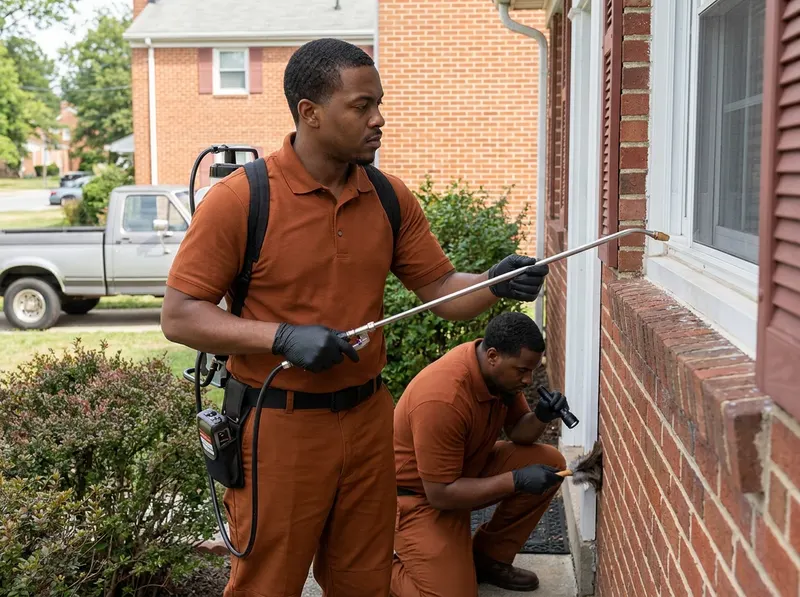
- Included: exterior residual treatment of south- and west-facing walls, window and door frames, attic and gable vents, soffit seams and cornice gaps, plus a written list of every opening found on the walkthrough.
- Timing and duration: best applied late August through October, before the first hard frost; a typical Baltimore rowhome exterior takes 45 to 90 minutes on site.
- Cost: $250 is the minimum charge for stink bug and boxelder bug work; most attached rowhomes fall between $250 and $400, larger detached or converted multi-unit properties between $375 and $750. Ballpark figures — the exact number is confirmed on a free on-site visit.
- What we handle: the exterior barrier, vacuum-out of visible clusters indoors, treatment of accessible voids, and sealing of vents, frames and utility penetrations. We do not fog living space or treat trees off the property.
- To book: call (667) 309-5283, say which side of the house gets afternoon sun, and we schedule the walkthrough and treatment in the same fall window.
Baltimore rowhomes are unusually good winter shelter for these insects, and the reason is architectural. Brick and formstone walls facing west or south hold heat well into a 55-degree October afternoon, which is exactly the surface temperature stink bugs aggregate on before they crawl. From there the openings are short: flat-roof parapet and cornice gaps, third-floor dormer trim, unscreened gable and attic vents, and the sash weight pockets behind original double-hung wood windows in Bolton Hill, Mount Vernon and Federal Hill. In Canton, Locust Point and Highlandtown, exposed rooflines and neighbor-to-neighbor cornice runs mean one untreated house feeds the block. Boxelder bugs follow trees rather than sun alone — box elder, maple and ash. Homes under the mature canopy in Roland Park, Charles Village and Hampden, or near the plantings at Cylburn Arboretum and Druid Hill Park, see the clustered red-and-black adults on foundation walls and porch columns most reliably.
Decide between the two paths by the calendar. If it is still fall and you are seeing insects on the outside walls, the exterior barrier plus sealing is the service that actually works, because the insects have not yet reached the voids. If it is January and they are walking across the ceiling of a Fells Point bedroom, the honest trade-off is this: they are already inside the wall, no spray reaches a bug sitting in a sash pocket, and interior treatment is limited to vacuum-out, accessible void work and monitoring until spring. That is why we book winter callers for a same-season interior visit and a scheduled treatment the following late summer — the fix is timing, not volume of product. Sealed out, not just sprayed is not a slogan here; a screened gable vent keeps working every year, while a residual on brick degrades with sun and rain.
A second consideration for Baltimore City specifically: this is an independent city with no county government layered above it, so alley-facing rears, shared cornices and party-wall roofs sit inches from a neighbor's untreated structure. On attached houses we treat what we can legally reach on your walls and tell you plainly which openings are on the neighbor's side, in writing, so landlords and tenants in converted rowhomes are not paying twice for a problem crossing a shared soffit. Small landlords get the same document to hand to the next unit.
Two practical instructions that save money. Do not crush them — the defensive compound gives stink bugs their name and staining is possible on painted trim and light fabric; vacuum instead and empty the canister outdoors. And expect a possible second exterior application after a heavy rain week or a warm November stretch, which we price as an add-on to the original visit rather than a new job. Before we leave, you get the product name, the treated surfaces, and the label re-entry and dry time in writing — usually a short exterior dry window, with children and pets kept off treated walls and foundation until it is dry.
What it costs
Every job gets a firm, written price after a free on-site visit.
Common questions
When is the right month for stink bug treatment in Baltimore?
Why do stink bugs cover only one side of my Baltimore rowhome?
Ready to get started?
Tell us about your stink bug and boxelder bug overwintering treatment job in Baltimore and we'll send a clear, written quote — usually the same day.